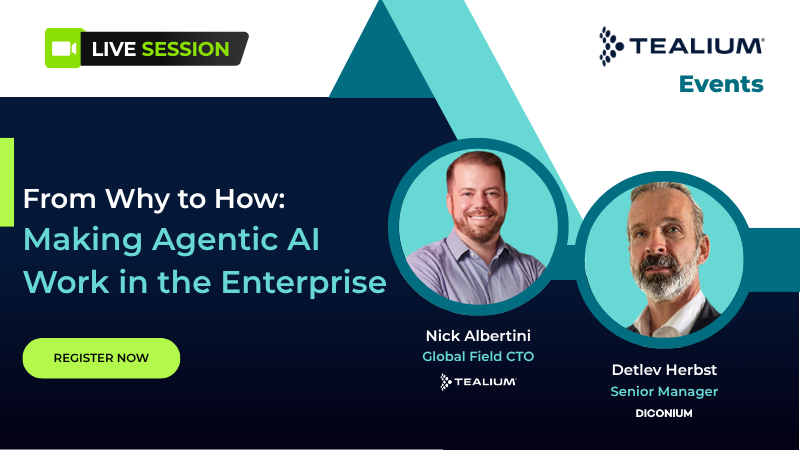
From Why to How: Making Agentic AI Work in the Enterprise
Tuesday, November 10
3pm GMT • 4pm CET • 7am PST
Many enterprises have tested AI. The harder step is putting it to work across processes and systems, with the context and controls required to act safely.
In this live conversation, Nick Albertini, Global Field CTO at Tealium, and Detlev Herbst, Senior Manager, Diconium, show how enterprises can move Agentic AI from isolated pilots into controlled execution. They connect the two capabilities required: the data and data-collection foundation that gives AI the right context, and the business processes, operating models and use cases that turn that context into action.
Save your seat
See you on November 10!
Check your inbox for your booking confirmation email – it will include your unique link to join this Zoom Webinar, and a link to add it to your calendar.
Got a colleague who might like to join too?
Invite them to register at:
https://tealium.com/event/making-agentic-ai-work-in-the-enterprise/
See you soon.
Live Webinar
Learn how to turn enterprise AI pilots into controlled execution across systems and processes.
AI programmes stall when agents lack current context, processes cross disconnected systems and no one has defined where human accountability begins. Tealium and Diconium show how data readiness and process design address these constraints together. Join this session to explore how to select a bounded use case, connect it to a measurable business outcome and define the controls required for execution. The speakers also explain how current, governed data enables an agent to act in real time.
You'll learn what this means in practice, using an automotive case: employees currently rebuild context across over a dozen systems, while an agent layer could coordinate specialised tasks, evidence and human decision points. We'll also show how the same principle applies to other industries including industrial service, retail and financial services.
You will leave with a clearer view of the data layer, process and control decisions required before an AI system can act across the enterprise.
What you will learn:
How to connect an AI use case to the business process, owner, handoff and human oversight required for safe execution.
How to identify and prioritise bounded use cases that can create measurable value without requiring unrestricted autonomy.
What changes when organisations move from legacy models and rapid-response LLMs towards agentic experiences and real-time activation.
Which foundations, including data readiness, governance, operating model and control mechanisms, need to be in place before AI can scale beyond a pilot.


 Read the Report
 Visit Marketplace
 Learn more