
Every software company seems to be building an AI agent.
That makes sense. Natural language is becoming a new interface for software, and people increasingly expect to be able to describe what they want instead of clicking through a dozen screens to make it happen.
But there is a bigger question the industry needs to answer:
Does every piece of software need to become the place where all of that work happens?
I don't think so.
In fact, I think the more important shift is happening in the opposite direction.
The future of enterprise AI will be defined by choice. Sometimes you will want to use the agent built directly into a product. Other times, you will want the AI assistant or agentic environment you already use to operate that product for you.
That distinction is at the heart of the latest expansion of Tealium's agentic capabilities.
Your agent should be able to work with your stack
Tealium has supported MCP-based access to trusted customer context for more than a year. That gives AI systems a way to use governed customer data as part of agentic experiences.
With Configuration MCP, that relationship goes further.
AI agents can now move from using Tealium data to working in Tealium itself. Teams can use MCP-compatible AI tools to create and modify Tealium configurations, including audiences, attributes, enrichments, and activation workflows.
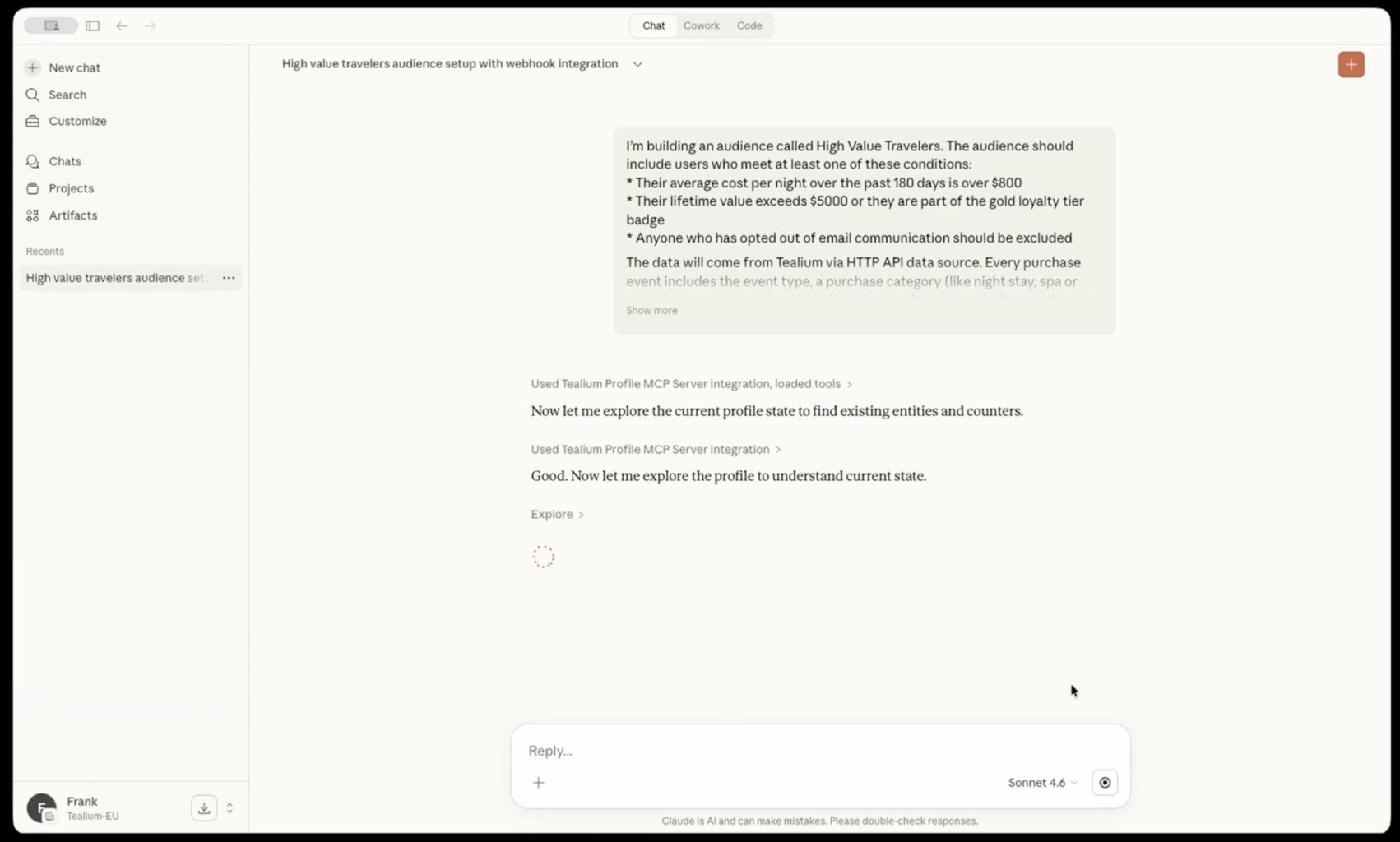
Imagine a marketer working through a campaign idea with the AI assistant they already use. They explore the audience. Refine the strategy. Work through messaging. Decide which customers they want to reach.
At that point, they shouldn’t need to stop, open another AI interface, restate the entire problem, and rebuild the context just because it is time to create the audience in their CDP.
They should be able to say: build that audience in Tealium.
Configuration MCP makes that possible.
The resulting configuration is not trapped inside the agent conversation. Proposed changes are validated and reviewed before publication, and approved configurations remain visible and editable within Tealium for the rest of the team.
AI can accelerate the work without creating an isolated operating model that only the person using the agent comprehends.
The goal should not be to own the entire campaign process
There is a temptation in martech today to treat AI as another reason to expand the boundaries of the platform.
If marketers are using AI to brainstorm campaigns, maybe the CDP should own campaign briefs.
Then campaign planning.
Then creative development.
Then approvals.
Then project management.
Where does it stop?
There will be customers who want a version of that experience, and native agentic interfaces have an important role to play. That is why we’ve built Tealium Studio. It gives teams a natural-language way to work directly within Tealium when that is the experience they prefer.
But that should be a choice, not a requirement.
Most enterprise marketing organizations already operate across a collection of systems. Strategy may happen in one place. Collaboration somewhere else. Creative development in another. Customer data lives across the warehouse and CDP. Activation happens through advertising, messaging, sales, and experience platforms.
And those workflows are going to keep changing.
The agent or interface a company prefers today may not be the one it prefers two years from now.
Trying to own the entire campaign planning experience assumes the vendor knows where the customer's workflow should begin and end.
A more flexible strategy is to make the platform operable wherever the work is already happening.
Agentic flexibility is an architecture decision
This is why I think MCP is more important than simply adding another chatbot to martech.
A proprietary assistant says:
Come here to use AI with our product.
An open agentic architecture says:
Use our AI experience if you want. Or bring the agent you already use.
Some teams will prefer a native agent because it is tightly integrated, highly contextual, and purpose-built for the platform.
Others will develop sophisticated workflows using broader AI environments that span multiple systems.
Developers may want APIs and configuration-as-code.
Marketing teams may want a conversational interface.
AI agents may need to operate across all of them.
The important thing is that they are working against the same governed platform underneath.
That is the strategy behind Tealium's broader agentic expansion: Configuration MCP for external AI agents, Tealium Studio for a native agentic experience, Platform APIs and a Developer Portal for programmatic workflows, and AI Recommended Audiences to help teams surface opportunities from the customer data already available to them.
Integration will matter more than ownership
The next generation of enterprise software will not win because it owns the biggest AI interface. It will win because it fits into the way people and agents already work.
That means giving customers options: use the native agent, use APIs, use automation, or use the AI assistant your company has standardized on.
The software underneath should still be useful no matter which interface sits on top of it.
That matters even more in martech, where the workflow has never lived neatly inside one application. Campaigns cross teams, systems, data sources, agencies, channels, and technologies.
The preferred platforms will not be the ones that demand control over that entire process.
They will be the ones that can participate wherever they are needed.
That is what agentic flexibility really means: not another place marketers have to work, but a platform that can work wherever they do.