In cloud analytics, the shift from fragmented data services to a single, cohesive ecosystem is no longer a luxury—it is a necessity. Microsoft Fabric represents this fundamental shift, unifying data ingestion, engineering, warehousing, and business intelligence into a single technology experience.
By integrating Tealium with Microsoft Fabric, organizations bridge the gap between real-time customer behavior and advanced analytical power. This integration doesn't just move data; it fuels Fabric’s AI with the high-fidelity, real-time context required to make intelligent decisions in the moment.
Why Tealium Context is the Best Fuel for Fabric AI
AI models, especially Large Language Models (LLMs) and Predictive ML, thrive on signal density and freshness. Standard data warehouse exports are often "cold," representing who the customer was yesterday. Tealium provides the "Live Signal":
- Eliminating the "Data Gap": Tealium captures signals and intent—like engagement patterns, category interests, and budget shifts—the moment they happen.
- High-Fidelity Inputs: Fabric’s AI models perform better when fed structured, real-time context (e.g., "User is currently browsing luxury villas") rather than raw, noisy logs.
- Session-Aware Intelligence: Tealium maintains the state of the current session, allowing Fabric to understand the sequence of events leading up to a prediction.
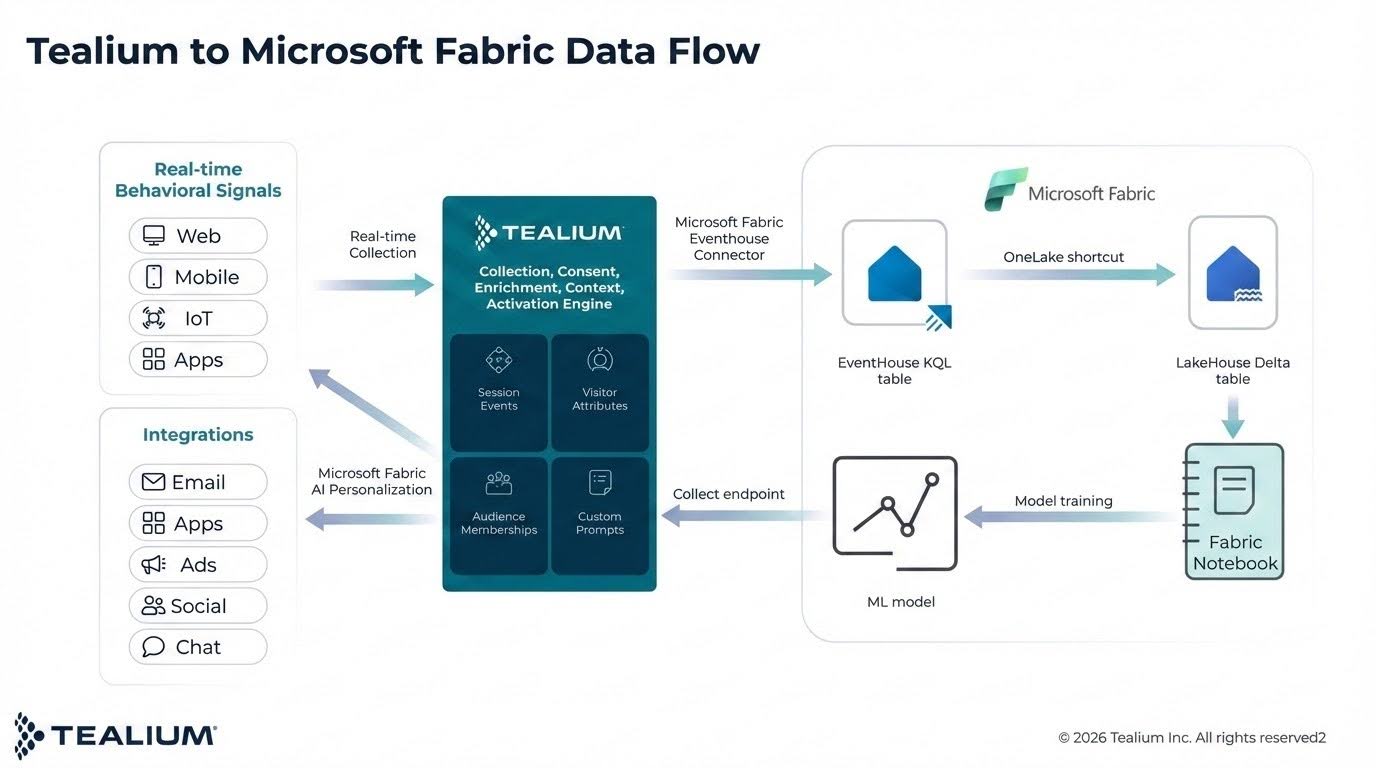
Visualizing the Intelligence Loop: Tealium → Fabric → Tealium
The Architectural Foundation: OneLake and Event House
To understand the integration, one must first understand the "categories" within Microsoft Fabric that support Tealium’s data streams:
- OneLake: The "OneDrive for data"—a centralized storage foundation where all data resides.
- Event House: The real-time powerhouse tailored for high-volume, high-velocity data. It uses KQL (Kusto Query Language) for lightning-fast querying of Tealium events.
- Data Factory & Notebooks: The engines used to transform and apply Machine Learning (ML) to the live data once it is inside the Fabric ecosystem.
How Data Flows from Tealium to Fabric
The integration begins at the edge. Tealium captures granular user behaviors and signals from any device and streams them through the Microsoft Fabric Event House Connector. By enabling "OneLake availability" on the KQL table, the data is mirrored into a Lakehouse in Delta format. This ensures the data is ready for AI indexing without the delay of traditional ETL. From here, data can be used for any application in Fabric, including AI workloads, and the processed data is then passed back to Tealium via API for activation across your organization's technology stack.
Key Use Cases: From Collection to Intelligence
AI-Powered Search and Discovery (RAG)
By mirroring real-time contextual events from Tealium into a Lakehouse, data can be indexed by Azure AI Search for Retrieval-Augmented Generation (RAG).
- The Mechanism: A Fabric Notebook transforms Delta records into JSON objects for indexing.
- The Result: An AI agent provides personalized recommendations grounded strictly in the current interests captured by Tealium (e.g., "Show me trips matching the $3,000 budget I just searched for").
Predictive Marketing via Machine Learning
Instead of reacting to what a user did, businesses predict what they will do next.
- The Mechanism: Fabric Notebooks processes historical and real-time Tealium data to train custom ML models (e.g., "Next Best Destination").
- The Activation: Once a prediction is generated, Fabric sends it back to Tealium’s collections API endpoint. Tealium then triggers this insight across all downstream vendors (Email, DSPs, and Personalization tools).
The "Intelligent" Custom Agent
This is a closed-loop interaction where the AI feels truly "human" because it has the full context of the user's journey.
- The Interaction: A user engages with a chat interface.
- The Intelligence: An LLM extracts entities from the chat, while Fabric’s ML model processes those entities against the real-time contextual data flowing from Tealium.
- The Result: A highly accurate recommendation delivered in milliseconds, reflecting the user's most recent clicks.
Real-World Application: The "Next Best Action"
Consider a traveler who just browsed "Food and Culture" trips to Asia.
- Inside Fabric: The ML model analyzes the real-time interest and budget signals. It predicts the next best fit is Vienna via Lufthansa.
- Through Tealium: This prediction is instantly sent to the engagement layer.
- Multi-Channel Execution:
- Web: A personalized pop-up appears: "Welcome back! How about Vienna?"
- Email: An automated email via any Email Service Provider (ESP) is sent, pre-populated with the predicted airline and destination.
Strategic Benefits of the Integration
| Benefit | Description |
| Real-Time Signal | Feeds Fabric AI the "live" customer state, not just historical snapshots. |
| Eliminated Silos | Moves ephemeral web behavior into a long-term, queryable asset in OneLake. |
| Predictive Accuracy | High-fidelity Tealium data leads to higher-confidence ML predictions. |
| Enhanced CX | Delivers conversational experiences that are grounded in actual user intent. |
| Simplified Governance | Secure, unified environment for all data transformations and model training. |
The Future of the Intelligence Loop
The integration of Tealium and Microsoft Fabric turns a collection of fragmented touchpoints into a sophisticated data loop. By fueling Fabric’s analytical engines with Tealium’s real-time context, businesses move beyond reactive marketing and toward a future of true, AI-driven predictive intelligence.
Ready to set up the integration? Here are the developer docs for Microsoft Fabric Eventhouse Connector