In the world of B2B catering equipment, the journey from a printed catalog to a high-velocity digital powerhouse is no small feat.
At one of Tealium’s client events, the data team from Nisbets shared their "rock star" moment: a deep dive into their first year implementing a Customer Data Platform (CDP).
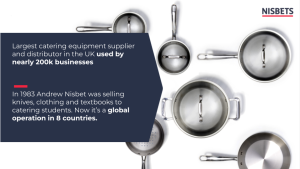
With a rich 40-year history, starting as a family business in 1983 and recently joining the FTSE 100 Bunzl Group, Nisbets faced a modern challenge: how to personalize journeys for a massive, global audience while mitigating signal loss from ad blockers and changing cookie rules.
Here is how they moved the needle in just 12 months.
Nisbets entered their CDP journey with a clear objective. While they had been using Tealium iQ for client-side tagging since 2015, they needed to bridge the gap between anonymous web traffic and known, loyal customers.
Their "North Star" metrics for the Proof of Concept (POC) were:
- Mitigate Signal Loss: Ensuring data reached paid media channels despite browser restrictions.
- Increase Addressability: Turning anonymous browsers into identifiable leads.
- Drive Personalization: Creating bespoke journeys for "Abandoned Browse" and "Abandoned Basket" segments.
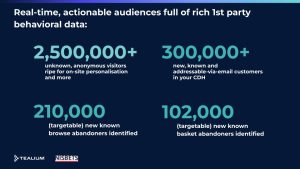
The results of their initial three-month pilot were enough to convince the board that the CDP was a vital investment. By leveraging Tealium EventStream and AudienceStream, Nisbets quantified the "unknown" and started winning it back.
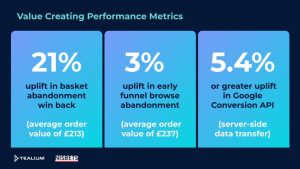
Perhaps the most significant win was a 5.4% increase in conversion visibility within Google Ads. For a business where paid media is the largest marketing spend, a 5% gain at the top of the funnel translates into millions in revenue.
After the POC success, Nisbets didn't just sit back. They rolled out the architecture across nine different websites, including markets in Australia, New Zealand, and Europe.
1. Bidding on Margin, Not Just Revenue
In a move to satisfy new investors focused on profitability, Nisbets shifted their Google bidding strategy. Instead of just chasing high-revenue items (like an expensive water urn with thin margins), they began sending margin data to Google. This allows them to bid more aggressively on high-profit items, like a box of teaspoons with an 80% margin.
2. The "French Connection"
In France, a massive market where Nisbets was looking to gain a foothold, they used Tealium to trigger exit-intent popups for unknown visitors. By offering a 10% discount to join the newsletter, they saw a 90% increase in email sign-ups.
3. Solving the "Lapsed Customer" Puzzle
Nisbets identified customers who hadn't purchased in 13+ months and used their Digital Experience Platform (DXP) to show them a unique "Welcome Back" 20% discount banner the moment they returned to the site—even if they hadn't logged in yet. This was made possible by Tealium’s identity stitching.
Commercial buy-in is vital. We wouldn't have gotten anywhere without demonstrating value. Money matters, and the data proved the ROI.
— Ed Ryan, Group Head of Customer Insights, Nisbets
The Nisbets team was candid about the hurdles they faced during their first year. Their advice for other brands?
- Campaign Size Matters: Don't get too "niche" too fast. If a segment is too small (e.g., "Lapsed pub owners who only buy glassware"), it becomes difficult to reach statistical significance in A/B testing.
- Collaboration is King: Get the CMO and the heads of PPC, Catalog, and Web in the same room. When everyone understands how the data helps their specific goals, the budget follows.
- Lean Teams Can Win: Nisbets managed this global rollout with a core team of just two people. By prioritizing "bang for buck" and scaling what worked in the UK to other regions, they maintained high velocity.
Nisbets is now looking toward Predictive Insights and Custom Attribution Models. By integrating Tealium’s data access with AI tools, they plan to map the entire path to conversion, ensuring every marketing pound is spent where it counts.
Ready to turn your anonymous traffic into your most loyal customers? Watch the full session here.
We brought together our entire marketing team, from web and PPC to catalog management, to align on a single goal. By asking, 'What do you actually need to be successful?' We were able to collaborate on a clear list of priorities. We now have a unified roadmap that defines exactly how we’re moving forward.
— Ed Ryan, Group Head of Customer Insights, Nisbets