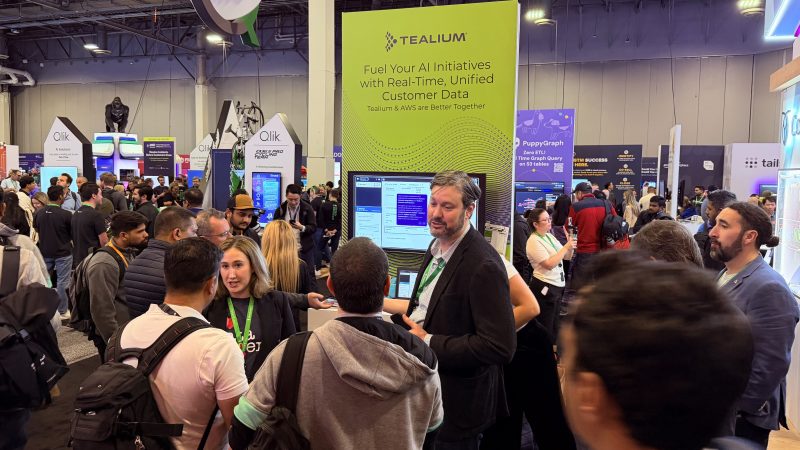
The Corinium CDAO Financial Services 2026 event in New York brought together senior data leaders from across banking and finance to tackle a central question: what does it actually take to operationalize data and AI in a regulated industry? Six themes kept surfacing across keynotes, panels, and breakout sessions.
1. AI Success Starts With Trusted Data
The loudest signal from the conference floor: AI doesn’t succeed without a strong data foundation. Speaker after speaker made the case that too many AI initiatives stall because organizations try to build models before they’ve solved for data quality, governance, and accessibility.
This resonates with what we see at Tealium every day. AI models are only as good as the data feeding them. Stale, fragmented, or ungoverned data produces stale, fragmented, ungoverned outputs. The organizations pulling ahead are:
- Treating data as a product — governed, auditable, and ready for real-time use
- Aligning AI programs with measurable business outcomes to move beyond pilot purgatory
- Investing in data quality and accessibility before scaling model development
2. Governance + Risk + Compliance Are Growth Enablers
Governance used to be the compliance team’s problem. Not anymore. Enterprise leaders across multiple sessions framed it as a competitive advantage. The thing that lets you move faster with AI, not slower.
- Effective governance builds customer trust and supports safer AI deployment
- Proactive risk management beats reactive compliance every time in regulated environments
- The firms treating consent and data governance as foundational infrastructure, not afterthoughts, are the ones scaling AI with confidence
3. Cross-Functional Collaboration Is Nonnegotiable
One of the more energetic panel discussions centered on breaking down organizational silos. Executives from institutions like Citi and Capital One shared examples of what happens when data, IT, and business functions actually align.
- Shared goals, shared language, and shared KPIs across teams accelerate everything
- When data scientists, risk managers, and business leaders operate in their own orbits, friction compounds
- Initiatives that used to take quarters start moving in weeks once teams are aligned
4. Modern Data Architecture Is Critical for Scale
Multiple sessions focused on modernizing data infrastructure to support real-time analytics and AI, including federated computing, decentralized architectures, and edge-ready solutions.
- Financial firms need infrastructure that supports both agility and scale
- Decentralized models and federated governance help organizations innovate without compromising security
- The question isn’t whether to modernize. It’s whether your current stack can support real-time event processing and AI activation at the speed your business requires
Batch architectures built for weekly campaign cycles can’t keep up with real-time customer expectations. The firms preparing for that reality now are building systems that won’t need to be rearchitected in two years.
5. Culture Matters: Accountability and Metrics Drive Results
Session after session reinforced that technology alone doesn’t transform organizations. Culture does. The practical guidance was refreshingly specific:
- Define meaningful KPIs tied to business outcomes, not just “data quality score”
- Embed data literacy and accountability into teams
- Make data-driven decision-making part of daily operations, not a quarterly initiative
6. Real Lessons From Peers, Not Vendor Pitches
A highlight of the event was the candor. Executives from Citi, Capital One, and First Citizens Bank shared real-world lessons: tackling data quality challenges, operationalizing AI, and scaling governance across global teams. The audience got concrete examples of data and AI applied to fraud prevention, edge computing, and compliance workflows, along with honest discussion about what didn’t work and how leaders are course-correcting.
Financial services is at an inflection point. The organizations that harness data and AI responsibly, with governance, collaboration, and scalable architecture, will outperform competitors and redefine what’s possible in digital finance.
Whether you’re a CDO, CAO, or data leader in any sector, the lessons carry universal value. Data strategy is as much about people and process as it is about technology. And the foundation for trustworthy AI? Unified, consented, real-time customer data. That’s not optional. It’s the starting line.