
For the last five years, the enterprise has been obsessed with data storage. We built massive Data Lakes, bought Customer Data Platforms (CDPs), and hoarded petabytes of customer information. We treated data like gold bullion—something to be locked in a vault, secured, and counted.
But in the era of AI and real-time expectations, data sitting in a vault is useless. In fact, it’s often a liability.
We are discovering a hard truth: Data is only valuable when it is moving.
This brings us to the necessary evolution of the marketing stack. We must move beyond the concept of a static CDP and embrace Customer Data Orchestration.
If the "Data Layer" is the dictionary that defines the language of your business, a Customer Data Orchestration platform—like Tealium—is the central nervous system that ensures that language is spoken fluently, in real-time, across every single touchpoint.
Why the obsession with movement? Because customer intent is highly perishable. It rots faster than fruit. Most are not thinking about the half-life of insight. We need to understand the concept of data decay. The value of a data point is at its absolute peak the millisecond it is created. Every second it sits in a database without being acted upon, its value drops for most industries.
Data at rest is for historians, .It tells you that a customer looked at mortgage rates 30 days ago. That is an interesting statistic for a quarterly report, but it is not a revenue driver. Data in motion is for operators. It tells you a customer is looking at mortgage rates right now. That is a trigger for immediate action.
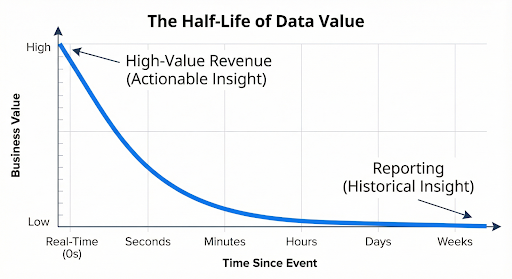
If you wait 24 hours for a batch process to "activate" that data, the customer has likely already applied for a loan with a competitor. Stored data describes the past; moving data changes the future.
This is where the industry understanding of platforms like Tealium often falls short. It is frequently categorized simply as a CDP. While it fulfills that role, calling Tealium a CDP is like calling a smartphone a "calculator." It technically does that, but you are missing the point of the device entirely.
Tealium is a Customer Data Orchestration platform. It is the difference between having a library of books (a database) and having a librarian who can instantly find the exact page you need and read it to you the moment you ask (orchestration).
To understand why this matters, let’s look at a common marketing failure caused by static data. Take for example, a travel/hospitality example that demonstrates data at rest vs data in motion.
The Data at Rest approach: Your static database knows this customer is a "Business Elite" frequent flyer who travels to New York every Tuesday. When they visit your site today, the personalization engine queries the database, sees "Business Elite," and immediately optimizes the homepage for efficiency: "Quick Rebook to JFK" and "Single Occupancy Hotel Deals." The Reality: The customer is visiting your site right now, but it is a Saturday morning. They are searching for "4 tickets to Orlando" and "Resorts with Kids Clubs."
They aren't a CEO today; they are a dad planning a dream vacation. The result is that you showed them a sterile, business-focused experience that felt completely irrelevant. You forced them to dig for what they needed, and they likely bounced to a competitor who showed them family fun immediately.
The Data in Motion (Orchestration) approach: The Orchestration platform sees the historical "Business Elite" tag, but it combines it with streaming context. It sees the search query "Orlando." It sees the parameter "Guests: 4." It sees that the browsing session is happening on a weekend. The result is that the orchestration platform instantly pivots the entire user experience. It suppresses the "Business Travel" interface and dynamically generates a "Family VIP" experience. It highlights the specific benefits of their Elite status that matter right now—like "Free Suite Upgrades" (perfect for a family of 4) rather than "Lounge Access" (which matters less). You didn't just recognize them; you anticipated their needs based on a couple of actions.
That is the difference between being annoying and being helpful. That difference is only possible when data is moving.
Real orchestration relies on three kinetic pillars:
- Identity Stitching in Real-Time.
In a fragmented digital world, your customer appears as a ghost: a cookie on a laptop, a device ID on a mobile phone, and an email address in a CRM. A standard data warehouse struggles to connect these quickly. Orchestration resolves these fragmented identities into a single profile as the user interacts. It turns three "ghosts" into one person before the session ends. - B2B lead routing.
When a prospect from a major account downloads a whitepaper, static systems often fail to match the lead to the account due to typos or data silos, creating "orphaned" leads. Orchestration fixes this in flight. It enriches the incoming lead with firmographic data, standardizes the company name, matches it to the correct Salesforce account, and alerts the Account Executive—all before the prospect has finished reading the PDF. - Orchestration.
This isn't about storing data for a report; it's about delivery. Consider the classic "Cart Abandonment" scenario. Static systems often send generic "You left something behind" emails because the specific product data didn't sync to the email provider in time. Orchestration streams the exact product context (Color: Blue, Size: Medium, SKU: 123) to the email vendor instantly. The result? The customer gets a hyper-relevant email with an image of the exact item they wanted, including how many are left in inventory, not a generic template.
And importantly, this shift to orchestration is mandatory for the future of AI.
We know that AI is only as good as the data it is fed. If you feed an AI agent raw, unstructured, static event logs, it will hallucinate. It lacks the context of "now."
Tealium serves as the essential "pre-processing" platform for the AI revolution. It generates AI-Ready Data.
Because the orchestration platform enforces the taxonomy and structure defined in your Data Layer, it ensures that the data flowing into your AI models is clean, labeled, and contextualized. It provides the necessary metadata—value, intent, recency—that AI needs to operate safely.
When you use a Customer Data Orchestration platform, you aren't just dumping hay on the AI and asking it to find a needle. You are handing the AI a magnetized needle, threaded and ready to sew.
Your data is your most valuable asset, but only if it is refined. A Customer Data Orchestration platform is the refinery. It takes the crude oil of raw interactions and turns it into the high-octane fuel that powers both your current marketing stack and your future AI initiatives.
Stop building vaults. Start building pipelines.